
A complete guide to semantic SEO architecture.
Semantic SEO architecture connects user intent, entities, content, URLs, internal links and structured data. The goal is not to fool a model, but to give every URL a clear function and verifiable information.
What is semantic SEO architecture?
It is a way of designing a site in which a business topic becomes a network of pages with distinct intents, clearly named entities, verifiable attributes and useful links between them.
Google publicly recommends helpful, reliable, people-first content, crawlable links and clear structured data. The terms “topical authority”, “micro-intent” and “cost of retrieval” are used in this guide as working models for design and QA. We do not present them as named Google metrics or as a ranking formula.
In working form, topical authority can be expressed as a ratio: ((historical data × topical coverage) ÷ cost of retrieval) × the right visual annotations, where visual semantics is a multiplier rather than an afterthought. It is not a unit of measurement but a way of seeing why coverage alone does not help when a site is expensive to process, and why page layout is not a subject separate from architecture. As a multiplier, a wrong annotation cancels everything else: neither the lowest processing cost nor the broadest coverage helps if the page’s main content is not what the query asks for. The threshold for opening a new page is covered on the query template page.
The limit: technically correct HTML and JSON-LD cannot compensate for an incomplete answer, inaccurate facts or an absence of evidence.
How is a topical map built?
The map is built in the order Macro Topic → Cluster → Page → Micro-intent. It starts from the function of the site, not from a keyword export.
- Define the macro topic. Broad enough to support the business goal, precise enough that you know what does not belong on the site.
- Group related needs. A cluster is not a folder for tidiness; it gathers questions that share entities, attributes and a user journey.
- Give each URL one dominant intent. Secondary questions are allowed only where they serve the main task.
- Set the boundary. Write down which question belongs to another URL and which anchor text leads there.
- Check the evidence. A page without a source, local data, a test or direct experience is usually a templated paraphrase.
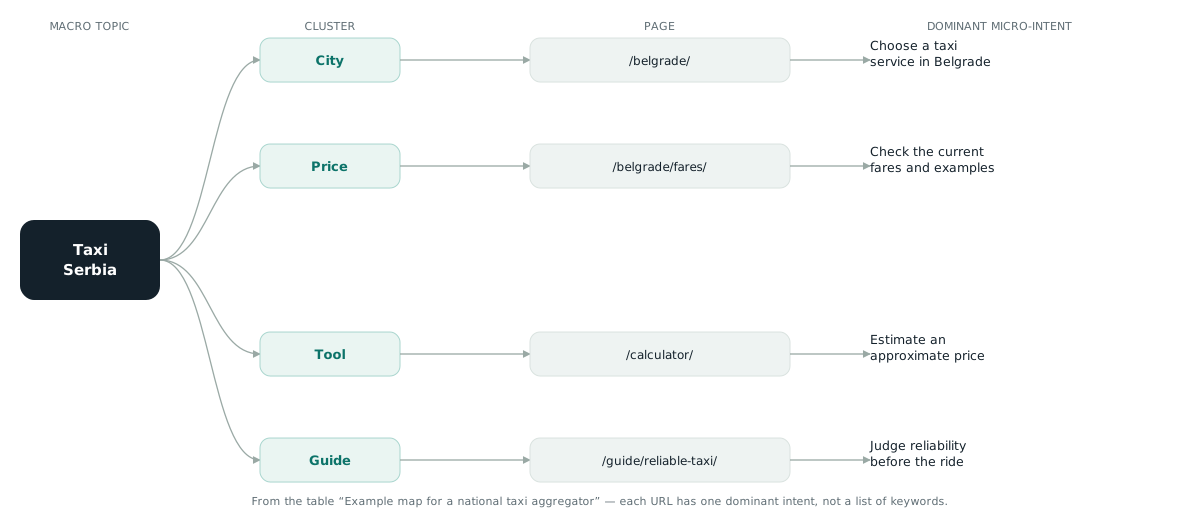
| Cluster | Page | Dominant micro-intent | Does not belong here |
|---|---|---|---|
| City | /belgrade/ | Choose a taxi service in Belgrade | A detailed formula for every fare |
| Price | /belgrade/fares/ | Check the current fares with examples | A directory of every city |
| Tool | /calculator/ | Work out an approximate price | A claim of a guaranteed price |
| Guide | /guide/reliable-taxi/ | Judge reliability before the ride | A list of phone numbers with no explanation |
How is an entity–attribute matrix built?
For each page, list the entity the reader must learn something about, the attribute they need, its source, where it is shown and, where applicable, the schema property. This matrix stops the visible text, the calculator and the JSON-LD from asserting different values.
| Entity | Attribute | Source | Visible surface | Machine layer |
|---|---|---|---|---|
| Service | Name and scope | Confirmation from the provider | H1 and description | Service.name, serviceType |
| Price | Value, currency, condition | Price list or regulation | Table and its caveat | Offer, only where it matches the content |
| Author | Identity and expertise | Public biography and work | Byline and About page | Organization or Person where verifiable |
| Image | Subject and function | The file itself and its context | Image, caption, alt text | ImageObject where justified |
If a source does not exist, the attribute is not filled in by assumption. It can be labelled as an estimate, or left out of the content entirely.
Micro-intents and cannibalisation
Two pages are not cannibalising each other simply because they use the same word. The problem starts when both try to be the best answer to the same task for the same reader.
- Different entity: “taxi Belgrade” and “taxi Niš” may share a format, but hold local data about different entities.
- Different stage of the task: a fare page answers the price question, a calculator performs the calculation, a service page enables contact.
- Same task, two pages: if two guides both answer “how much does a taxi cost in Serbia”, they need to be merged or their scope clearly separated.
A practical check: write a one-sentence answer to “This URL exists so that the reader can…”. If two pages finish that sentence the same way, examine the overlap.
We found exactly this on our own project. Two URLs targeted the same price query; the weaker one sat at position 9.35 while the stronger held 5.35. The finding and its resolution are documented in the audit example.
How are internal links designed?
A link exists where the next page naturally continues the task, explains a term or enables an action. There is no need to forbid relevant links between folders.
Google recommends that important pages are linked from other relevant pages and that anchor text is descriptive, with meaningful surrounding context. That is why “protocol for testing visual search” is a better anchor than “click here”.
| From | To | Function |
|---|---|---|
| Hub | Spoke | Choosing a specific task |
| Spoke | Hub | Returning to the wider overview |
| Sibling | Sibling | Continuing a process or supplying a necessary explanation |
| Educational page | Service | A functional next step, without aggressive repetition |
Quality nodes on the home page
The home page is not merely a junction. The links on it are a statement of which pages the site itself considers its best, and a crawler uses them as an early judgement on whether to go deeper. Martin Splitt of Google describes how a crawler that reaches unique documents with real human effort behind them from the home page becomes more inclined to crawl further.
| Link | Do not link in the main content |
|---|---|
| Pages with your own data, a test or evidence | Every page from every section in turn |
| The commercially most important page | Legal and utility pages |
| An entry point that leads onwards | Pages that exist only for coverage |
The most important pair is targeted from the most important page
On local projects, the most important service-and-location pair should be targeted by the strongest page, usually the home page, because it carries the most internal links and is crawled most often. The common failure is the opposite: the home page, the about page and the main service page compete with one another, because they share the same signals — internal links, query relevance, click data and the URL listed in the business profile.
A verifiable test: write the sentence “this page exists so the reader can…” for the home page and for the main service page. If they end the same way, one of them has to change its intent.
How does content reduce the effort of finding an answer?
Give a direct answer immediately below the actual question, then the conditions, the exceptions and the evidence. This helps the reader and makes parsing easier, but it is not a guarantee of an AI citation or of ranking.
- The H1 names the topic and the dominant intent.
- The opening paragraph gives a self-contained answer without marketing preamble.
- H2 and H3 follow the user’s journey, not a list of synonyms.
- Tables are for comparison; lists are for sets; numbered steps are for processes.
- Facts carry a source and a date wherever they can change.
- Estimates carry their formula, assumptions and limits.
- Recommendations explain why they help and when they do not apply.
Clear sentences are good because of readers. There is no need to force every sentence into subject–predicate–object, nor to claim that such syntax is a special form of BERT optimisation.
What does a cohesive JSON-LD graph look like?
A single block can connect Organization, WebSite, WebPage, BreadcrumbList, Article or Service and the relevant images. What matters more than the number of nodes is that every node represents content that is genuinely visible and justified.
{
  "@context": "https://schema.org",
  "@graph": [
    { "@type": "Organization",
      "@id": "https://example.com/#org",
      "name": "Example" },
    { "@type": "WebSite",
      "@id": "https://example.com/#website",
      "publisher": { "@id": "https://example.com/#org" } },
    { "@type": "WebPage",
      "@id": "https://example.com/guide/#webpage",
      "isPartOf": { "@id": "https://example.com/#website" } },
    { "@type": "Article",
      "@id": "https://example.com/guide/#article",
      "mainEntityOfPage": { "@id": "https://example.com/guide/#webpage" } }
  ]
}
This is a structural example, not a complete Article to copy. The properties you need depend on the visible content and on the guidelines for the specific rich-result type. For implementation see the schema markup guide.
How is the system checked before publishing?
| Gate | Question | Check |
|---|---|---|
| Intent | Does the URL have one dominant function? | A one-sentence definition of the task |
| Coverage | Are the necessary entities and conditions covered? | The entity–attribute matrix |
| Gain | What here is original or locally verifiable? | A source, a test, data or experience |
| Structure | Is the document accessible and logical? | Headings, landmarks, tables, images |
| Graph | Do the links and the JSON-LD describe the same system? | Schema validator plus a link review |
| Consistency | Do values agree across every surface? | Search for outdated values and validate the data |
After publishing, measure indexing, impressions, clicks and conversions separately. A change in position without conversions may not solve the business goal; more conversions without more traffic can be the better result.
This guide is a method. What it looks like applied to a real site, with a price and a timeline, is shown by the semantic SEO audit.
Want this map for your own site?
Send a URL and your dominant business goal.
Request an assessmentFrequently asked questions
How many pages must a topical map have?
There is no prescribed number. A map has as many pages as there are distinct, commercially relevant tasks that deserve their own URL and for which enough evidence exists. Ten complete pages can be more useful than a hundred templated ones.
Does changing dateModified strengthen a trust signal?
The date can help Google understand more precisely when an article changed, but it should only be changed when the content actually changed. We do not present refreshing a date as a ranking or trust factor in its own right.
Does schema markup directly improve rankings?
Google uses it to understand content better and for eligibility for certain rich results. That is neither a guarantee of display nor a documented direct ranking boost. The effect is measured, not assumed.
Do AI Overviews require special markup?
Google currently points to the same basic SEO practices: availability for indexing, useful content and compliance with Search guidelines. There is no separate “AI Overview schema” that guarantees a citation.
This guide is a method. How it looks when carried out on a real site, with a price and a timeline, is shown by the semantic SEO audit.
Want this map for your site?
Send the URL and your dominant business goal.